The short version
Pick a real date and one host. Invite the group about three weeks ahead, give every contribution one owner, close RSVPs one week before dinner, and ask guests to arrive with food ready to serve or with a specific finishing plan. The host owns the gaps; the group owns the meal.
Build the live contribution plan
The table below is a useful ten-person example. For a guest count that changes, use the free interactive planner to assign owners, watch the category gaps close, and copy one current plan back into the group chat.
Use the free potluck planner
No account is required. The gathering name, people, and dishes stay in your browser tab unless you choose to copy or share them.
Choose the date before the menu
Friendsgiving is flexible by design. Choose the evening that gives the core group the best chance of attending instead of forcing the gathering onto Thanksgiving itself. For a Canadian group, the weekends of October 3–4 and October 17–18 are useful starting points. For a U.S. group, consider November 14–15 or December 5–6.
State the date as a decision, not an open-ended question. If input is genuinely needed, offer two real options and a 24-hour deadline. A host can adjust once; the plan should not remain permanently provisional.
The invite-ready minimum
A date, start time, address, host, RSVP cutoff, contribution plan, and one place to see the current version. Add a theme only if it makes choices easier.
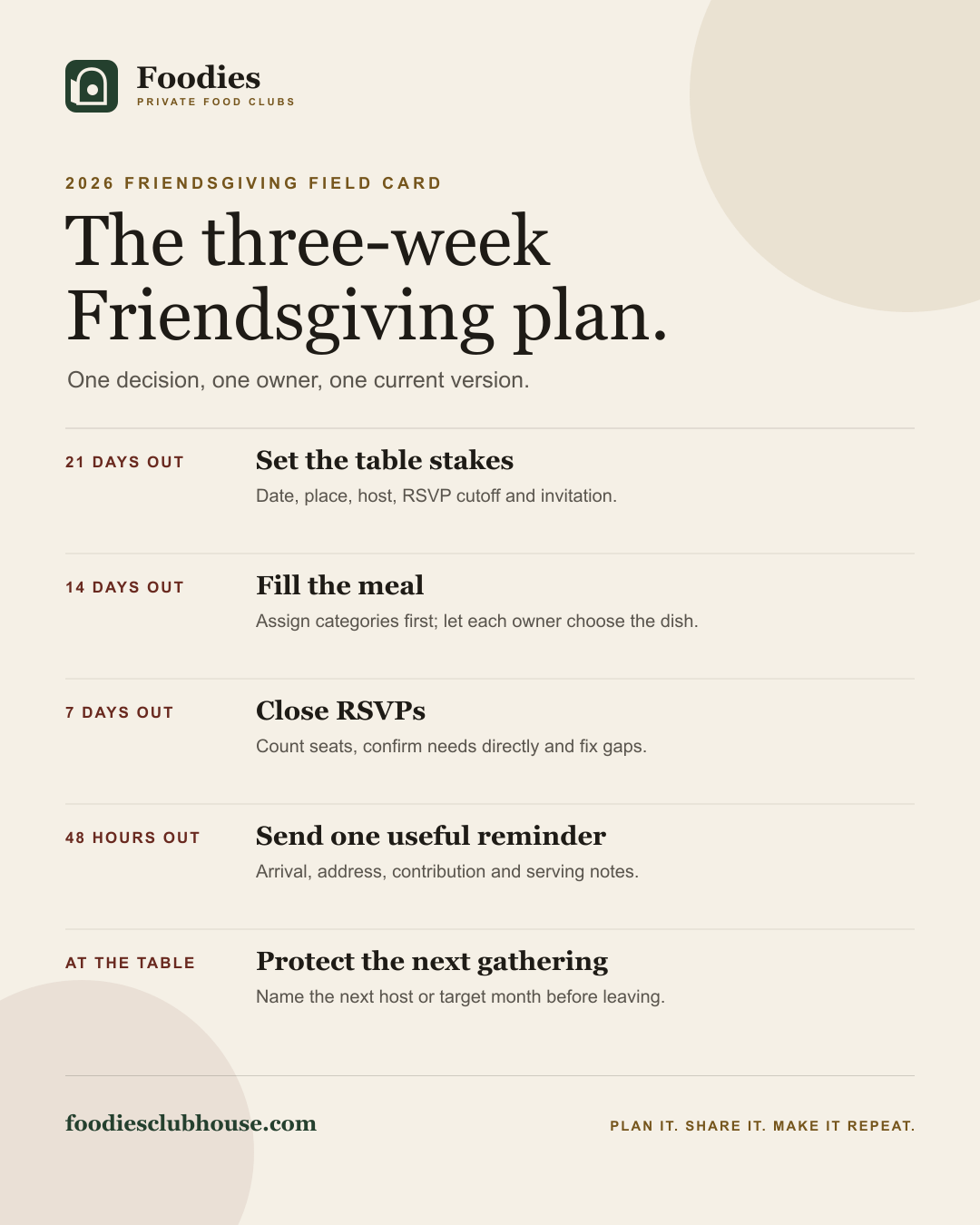
The three-week Friendsgiving timeline
Set the table stakes
Confirm the date, place, guest list, meal format, and who is handling the main dish. Send the invitation with the RSVP and contribution deadlines.
Fill the meal, not every recipe
Assign categories first: main, substantial sides, vegetables, bread, dessert, drinks, and service supplies. Let each owner choose the actual dish.
Close RSVPs and fix gaps
Count seats, confirm dietary needs directly with the group, and rebalance the contribution list. The host claims any essential gap that remains.
Send one useful reminder
Repeat the arrival time, address, assigned contribution, serving expectations, and parking or entry note. Ask for changes now, not while the oven is full.
Protect the next gathering
Before the night ends, name the next host or a target month. Save a short private recap so the good parts become club memory.
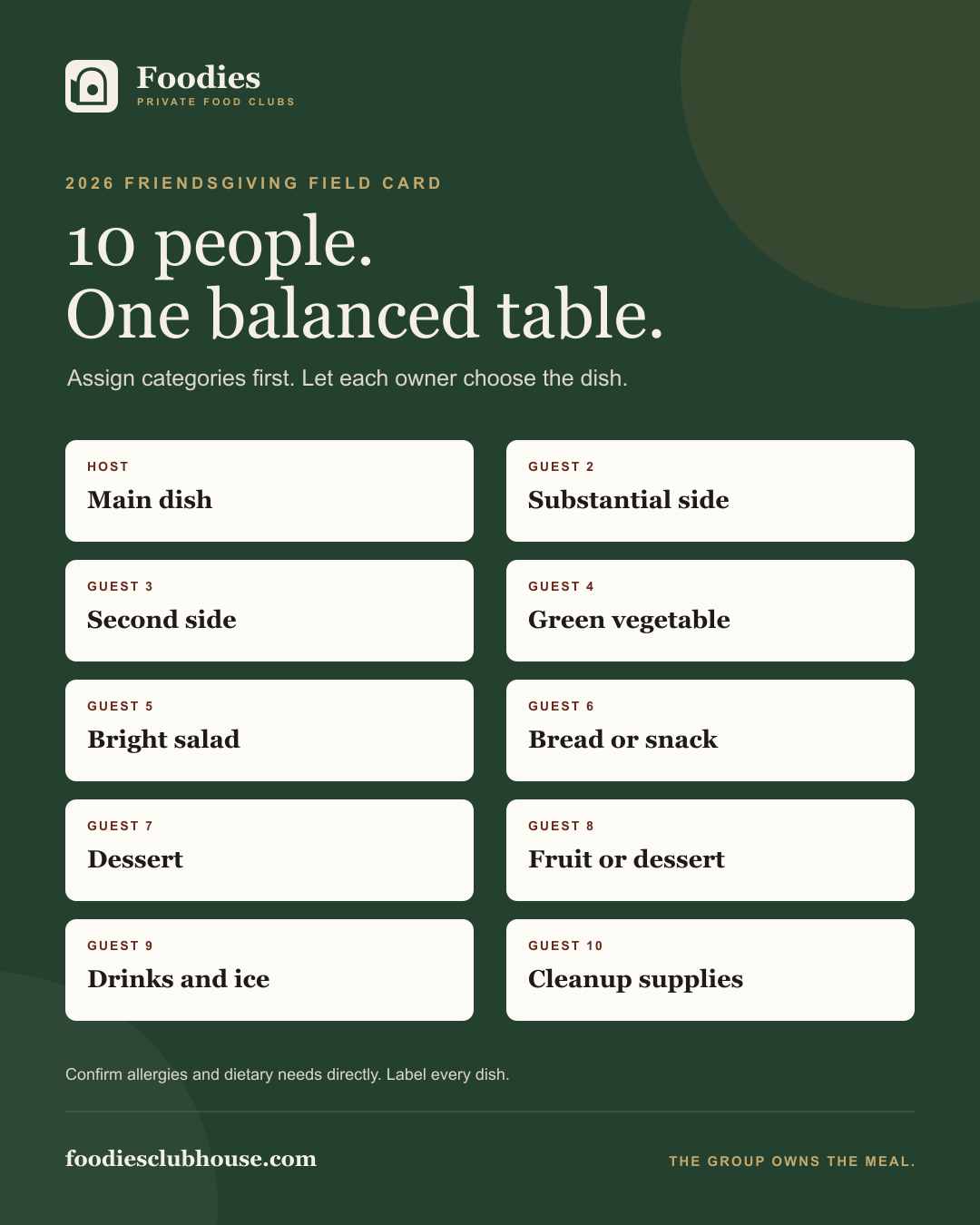
A balanced contribution plan for ten people
This is an operating example, not a required menu. Count people rather than households, and combine roles when guests are attending as a pair.
| Owner | Contribution | Service note |
|---|---|---|
| Host | Main dish or centrepiece | Ready to rest before guests arrive |
| Guest 2 | Starch or substantial side | Arrives hot or reheats in one vessel |
| Guest 3 | Second substantial side | Different base from the first side |
| Guest 4 | Green vegetable | Ready to serve; no oven required |
| Guest 5 | Bright salad or acidic side | Dressing packed separately |
| Guest 6 | Bread, butter, or snack | Can land on the table immediately |
| Guest 7 | Dessert | Includes any serving utensil |
| Guest 8 | Second dessert or fruit | Contrasts with the first dessert |
| Guest 9 | Drinks and ice | Includes alcohol-free options |
| Guest 10 | Containers, napkins, or cleanup | Owns the overlooked practical layer |
Food safety note: ask guests about allergies and dietary needs directly, label dishes, keep cold food cold and hot food hot, and avoid making safety assumptions from a dish name. Foodies does not detect allergens.
Copy-ready Friendsgiving invitation
The useful invitation
Friendsgiving is happening on [day, date] at [time] at [place]. I’ll host and handle [main/host contribution]. Please RSVP by [date], then claim one open contribution so the table stays balanced. Bring your dish ready to serve if possible and tell me directly about allergies or dietary needs. The current plan lives here: [link].
If the group is new, add the intended feeling in one sentence: relaxed and abundant, ambitious cooking, family recipes, a cookbook challenge, or a weeknight-friendly meal. That sentence settles more decisions than a long list of rules.
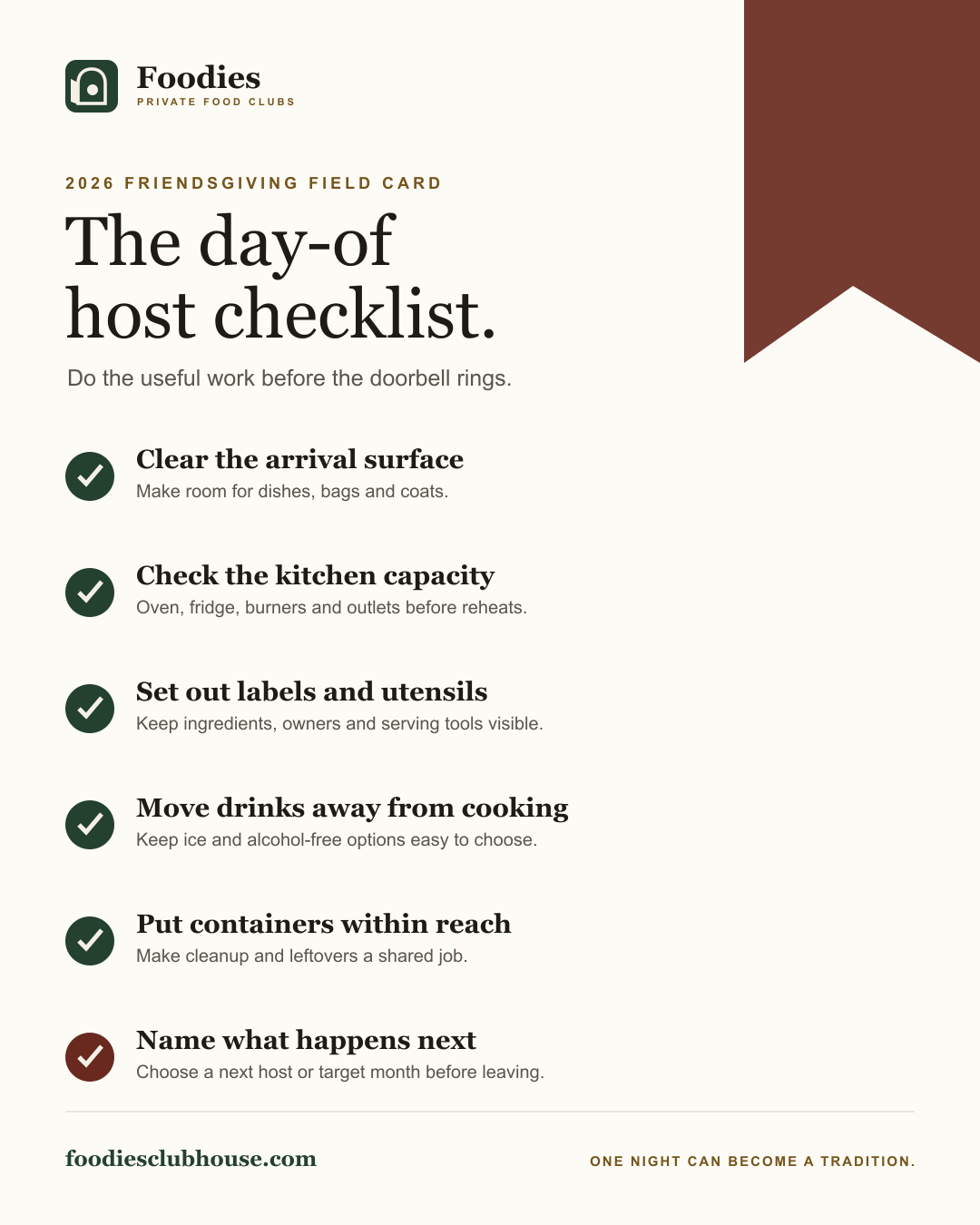
The day-of host checklist
- Clear one arrival surface for incoming dishes, bags, and coats.
- Confirm oven, fridge, outlet, and burner capacity before promising reheats.
- Set out labels or cards so ingredients and owners stay visible.
- Choose one place for drinks and ice away from the cooking path.
- Put trivets, serving utensils, napkins, and leftover containers where people can find them.
- Keep one alcohol-free drink visible and easy to choose.
- Photograph the table only with the group’s consent; keep private gatherings private.
- Before people leave, name the next host or target month.
Save the plan for the group chat
Download any of these no-gate 1080 × 1350 PNG field cards. Share the one your group needs now, then send the full guide when someone is ready to host.
 Download the three-week planPNG · 1080 × 1350
 Download the contribution planPNG · 1080 × 1350
 Download the host checklistPNG · 1080 × 1350
Where Foodies fits
A shared note can run one potluck. Foodies is built for the part after that: a private club with its identity and members, a current gathering, visible contributions, and a recap that gives the next host context. It is useful when Friendsgiving is becoming a dinner club rather than remaining a one-night event.
Foodies does not choose recipes, verify allergens, buy groceries, process payments, or replace direct communication about food safety. See the supper club app for the current product scope, or use the free supper club starter kit to establish a repeatable rhythm before creating an account.
What to use next
Sources, authorship, and seasonal maintenance
Created by Foodies Clubhouse Editorial and reviewed by the Foodies founding team. Published July 15, 2026. The 2026 dates are checked against the Government of Canada and U.S. Office of Personnel Management holiday calendars. The operating examples are original Foodies guidance grounded in first-party recurring-club experience and the current verified Foodies workflow. We will review this page before the Canadian, U.S., and year-end planning windows and complete a post-season retain, refresh, combine, or retire review in January 2027.